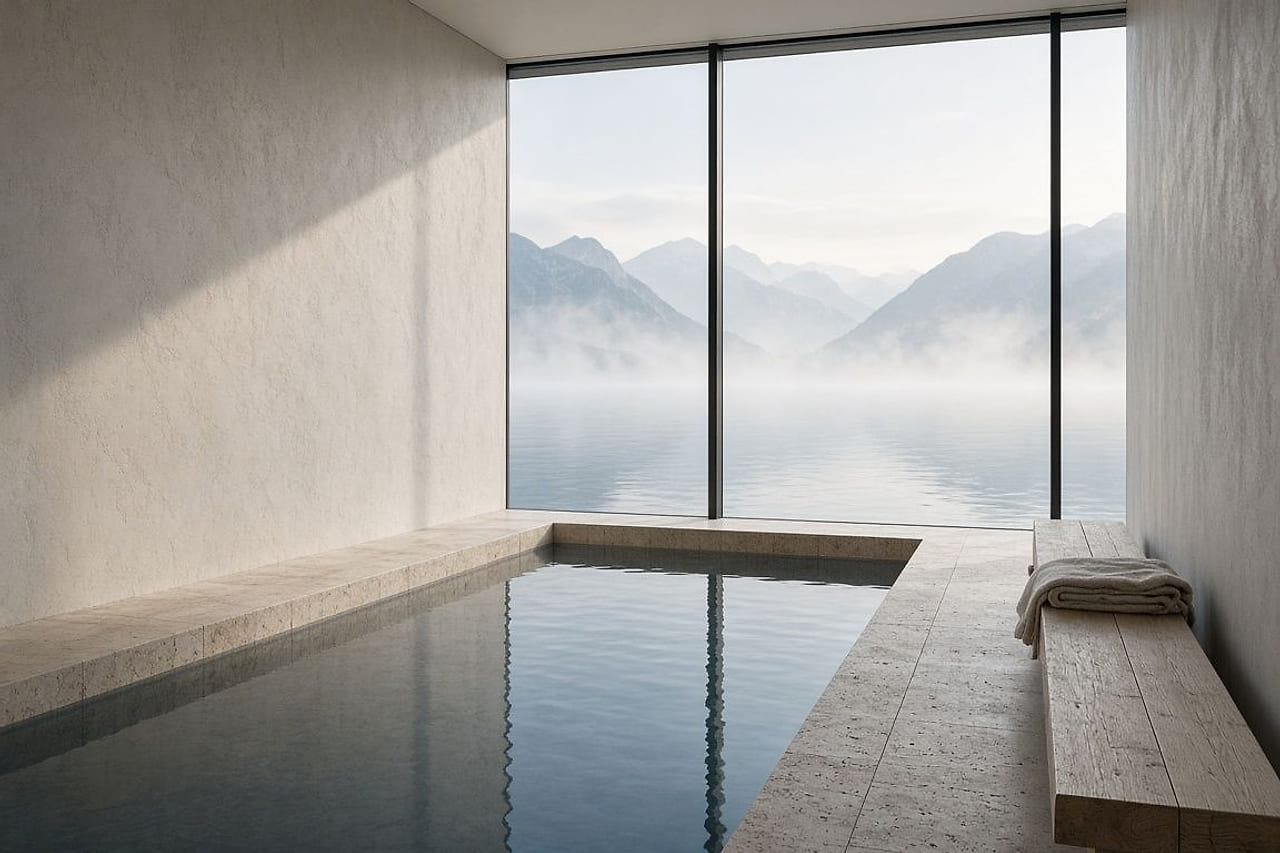
Switzerland has always taken its water seriously. Long before anyone said “wellness”, people came to its lakes and high valleys to sit in warm springs, step into cold ones and do very little in between. The Belle Époque built palaces around the habit; the late twentieth century gave it concrete, quartzite and quiet. What remains is less a spa culture than a temperament: unfussy, a little austere, and exact about temperature, stone and time.
This is the first of our weekly bathing notes from Europe, and it begins where the tradition runs deepest. Seven places, from Geneva to the Engadin, each with the thing worth knowing before you go. At the end, a short way to bring the ritual home.

A tradition of temperature
Swiss bathing comes in three registers. First the thermal: mineral water that rises warm from deep in the rock, and the towns, Leukerbad and Bad Ragaz among them, that grew up around it. Then the lake: cold, clear and swum in all year by people who think nothing of it. And finally the air, which is why nineteenth-century travellers wintered on the shore at Montreux, where the slopes shelter the water. A good Swiss bathing day touches all three.
The Ledger
Bains des Pâquis
A wooden bathhouse first stood here in 1872. The one you walk onto today, a long, low white jetty of reinforced concrete pointing into the lake, dates from 1931–32. In 1988 there was a plan to replace it, and Geneva’s voters turned it down by a wide margin. That vote tells you what the place is: it belongs to everyone. In the cold months it becomes a sauna, hammam and Turkish bath with steps straight into the lake, the Jet d’Eau on one side and, on a clear day, Mont Blanc on the other.
- Season
- The winter sauna runs from September 20, 2026 to May 23, 2027.
- Good to know
- Tuesdays are for women only. On full-moon nights the sauna stays open until midnight, and in winter there is fondue at the jetty’s buvette.
Montreux and the Riviera
Montreux was a winter resort before it was a summer one. Sitting between the lake and the mountain, it has a sheltered, gentle microclimate, and from the 1870s its shore and the slopes above filled with hotels for guests who stayed for months: the Caux Palace opened in 1902 and the Montreux Palace in 1906. In 1931 Clinique La Prairie opened at Clarens, on the town’s western edge. The best way in is still the old one: a Belle Époque paddle steamer along the shore, then a rack railway up to Glion or Caux, where avenues of trees and benches were laid out for long, slow afternoons.
- Why go
- For the light on the water, the air and the Belle Époque setting rather than any one bath.
- Good to know
- The paddle steamer Montreux has been in service since 1904. Steamer timetables change with the season, so check them before you plan your day around one.
Leukerbad
Leukerbad sits at the end of its valley under sheer limestone walls, and it is usually described as the largest thermal spa resort in the Alps. Its 65 springs deliver close to four million litres a day, the hottest at up to 51 °C. The water begins as rain and snow on the peaks between 2,300 and 3,000 metres and spends about forty years underground before it surfaces. In winter you notice it in the street: steam rising from manhole covers and warm water running in the village fountains.
- Why go
- To bathe outdoors under the cliffs, ideally with snow on the ground.
- Good to know
- The St. Lorenz spring alone gives about 900 litres a minute. By rail, take the train to Leuk, then the bus up the valley.
Bad Ragaz and the Tamina Gorge
The story begins with hunters, who are said to have found a warm spring deep in the narrow Tamina Gorge around 1240. By 1350 wooden bathhouses rested on beams above the river. Between 1704 and 1718 the abbots of Pfäfers put up the stone bath buildings that still stand, in part, as the Altes Bad Pfäfers. In 1840 a pipeline four kilometres long brought the water down to Ragaz, which took the name Bad Ragaz in 1936. The water still leaves the rock at a steady 36.5 °C, from more than 1,000 metres down.
- Why go
- For the walk: a path follows the gorge, past the old baths, to the grotto where the water comes out of the rock.
- Good to know
- Gorge access depends on season and weather, so check before you go.
Vals
At the head of a long valley, Peter Zumthor’s thermal bath opened in December 1996. It is built from about 60,000 slabs of local quartzite, quarried roughly a kilometre away, and the architect’s guiding image was of rock blocks standing in water. He wanted a bath you experience, not a fun pool, and it reads that way: stone, water and shadow, with rooms held at different temperatures. It has been a protected monument since 1998.
- Why go
- For architecture you take in with your skin as much as your eyes.
- Good to know
- The bath is now called 7132 Therme. Day visits are booked online in timed slots, capacity is limited and some dates are closed to outside visitors, so book well ahead.
St. Moritz Bad and the Mauritius spring
Before St. Moritz was a ski town, it was a spa town. In the old Bad quarter, a spring capture built of larch trunks has been tree-ring dated to 1411 BC, which makes it the oldest preserved one in Europe. The water is cold, rich in iron and naturally sparkling. Paracelsus came in 1535 and wrote about it with admiration. Since 2014 the larch capture has been on display at the Forum Paracelsus in St. Moritz Bad.
- Why go
- For one of the oldest traces of bathing culture in Europe, and the cold, bright Engadin light.
- Good to know
- Pair it with a winter walk around the lake. The town is about two hours from Chur on the Rhaetian Railway.
The cold half: Kneipp basins and the Coupe de Noël
The other half of the Swiss ritual is cold. All over the country there are public Kneipp basins: shallow channels of cold running water with a handrail, where you wade a few high, stork-like steps, then get out and warm up again. The practice goes back to the nineteenth-century priest Sebastian Kneipp. In Chur, the Obere Au basin is fed by the Mühlbach stream and is free and open all year. And every December since 1934, Geneva swims the Coupe de Noël: about 100 metres along the Jardin Anglais, in water that is usually between 5 and 10 °C.
- Good to know
- Cold water is a real shock. Keep it brief, swim only where there are other people around, and check with your doctor first if you have a heart condition or are pregnant.
The ritual, at home
You don’t need a mountain. The Swiss sequence works in an ordinary bathroom on a Sunday evening, as long as you give it an hour and leave your phone in another room.
- Before · 10 minutes
Prepare the room
Warm the bathroom, dim the light and lay out a heavy linen towel, a robe and a glass of water. If you use a pre-shampoo mask, apply it now, to dry hair.
- Warm · 15 minutes
The long warm
Run a bath or a long shower, as warm as is comfortable and no warmer. Let the room fill with steam. Take your time.
- Cool · 30 seconds
A cool finish
To close, run cool water over your feet and calves, the way you would in a Kneipp basin. Make it as cool as feels good, not as cold as you can stand.
- Rest · 20 minutes
Nothing at all
Wrap up and lie down somewhere quiet. Swiss baths keep a rest room for exactly this, and it is the part most people skip.
- After
Finish slowly
A few drops of oil on the ends of your hair, a mist of scent once it is dry, then an early, simple dinner.


Who it’s for, and when
Anyone who would rather have a long walk and a hot bath than a treatment menu. It suits one person travelling alone, a couple, or two friends with rail passes and no agenda.
October to March is the season: the lake saunas are open, the springs steam in the cold air, and outside the school holidays it is quiet. In summer the lake baths go back to being lidos, which is a pleasure of its own.
A bathing week, in three moves
- Start in Geneva with an evening at the Bains des Pâquis, then take the train along the lake to Montreux.
- Head up the Rhône valley to Leuk and take the bus to Leukerbad, for warm water and snow.
- Finish in the east: book a Vals slot well ahead, or carry on to St. Moritz for the old spring and the Engadin light.
Bring the ritual home
Four pieces from The Gloss Shop that suit the warm, cool, rest rhythm. We chose them for texture and scent, not for promises.

Pre-Shampoo Purifying Mask with White Clay, 200 ml
A white-clay mask for the slow start of the evening, before the water is even running.
- Key ingredients
- White clay with Java tea, celery seed and artichoke leaf extracts, plus alpha-bisabolol, cottonseed oil, vitamin E and pro-vitamin B5.
- What the brand says
- A “reset” for scalp and hair that absorbs impurities, pollution and excess oil, in a light, fresh texture.
- How to use
- Apply to dry scalp and hair, section by section, with the nozzle. Massage in, leave for 10 minutes, rinse, then shampoo.

Cell-Power Lipo Shower Gel
A shower gel worth leaving out by the bath, or pouring straight into it.
- Key ingredients
- Mild cleansers with a coconut- and sunflower-derived lipid, cationic guar and plant extracts including centella, green tea, licorice, chamomile and rosemary.
- What the brand says
- An energizing gel that leaves skin feeling revitalized and nourished.
- How to use
- Lather in your hands, massage over damp skin and rinse. For a bath, add two hazelnut-sized amounts under the running tap.

Precious Hair Care Oil, 100 ml
For the rest that follows: a few drops on the ends while you do nothing at all.
- Key ingredients
- Moringa, shea, passion fruit and cottonseed oils.
- What the brand says
- Nourishes and smooths hair, for a glassy shine.
- How to use
- Warm 2 to 3 drops between your palms and smooth through mid-lengths and ends.

Hair Perfume Grace, 50 ml
The last step, once your hair is dry: a little borrowed sunshine for a winter evening.
- Key ingredients
- A care formula with panthenol, sunflower seed extract and cranberry extract.
- What the brand says
- Luminous and sun-kissed: it opens bright, then settles into a soft, creamy floral.
- How to use
- Mist over dry hair from 25 to 30 cm.
Shop the ritual
The four pieces in our Sunday bathing ritual are available in The Gloss Shop.
- Pre-Shampoo Purifying Mask with White Clay, 200 ml$130.00Shop now (opens in a new tab)
- Cell-Power Lipo Shower Gel$108.00Shop now (opens in a new tab)
- Precious Hair Care Oil, 100 ml$135.00Shop now (opens in a new tab)
- Hair Perfume Grace, 50 ml$82.00Shop now (opens in a new tab)
Orders are fulfilled and shipped by our partner boutique. Free US shipping on orders of $75+. Prices as listed on October 22, 2026. Disclosure: we have a business relationship with our partner boutique. #ad.
- Image: Gather & Gloss (AI-generated): lakeside bathing room
- Image: Gather & Gloss (AI-generated): alpine terrace basin at blue hour
- Image: Gather & Gloss (AI-generated): stone steps into a lake
- Image: Gather & Gloss (AI-generated): travertine ledge
All four images were generated with AI by Gather & Gloss in our editorial style. They are illustrations, not photographs of any place named in this story, and they show no products. Product images are supplied by the brands through our partner boutique.